
Industries · Education
Most of your learners are children. The Act treats them that way.
An edtech platform or a school group collects data on students from admission onwards: names, dates of birth, parents' phone numbers, fee payments, test scores, class recordings and app activity. Most K-12 students are under 18, so their data comes with extra duties. Counsellors, tutors and sales teams often see more than they need.

What you hold
The personal data in a typical week
The register every duty starts from. In TrustOS each category is linked to the systems that hold it, the purposes it serves and an owner.
Data register · Education6 categories
- Student names, dates of birth and photos
- Parent and guardian contact details
- Fee payments and scholarship documents
- Test scores, report cards and attendance
- Live class recordings and chat logs
- App usage and learning activity data
Pressure points
Where the DPDP Act bites in education
Verifiable parental consent
Before processing a child's data you need verifiable consent from a parent or lawful guardian. A checkbox on a signup form that a 14 year old can tick is not enough.
No tracking or targeted ads for children
The Act bars tracking, behavioural monitoring and targeted advertising directed at children. The Rules allow some processing by educational institutions for learning and safety, so record which activities rely on that.
Sales calls built on student data
Counselling and sales teams often call parents using leads from free trials and scholarship tests. Each list needs a purpose and a ground you can explain.
Records after a student leaves
Transcripts and certificates may need to be kept. Class recordings, chat logs and app activity of a student who left three years ago usually do not.
How TrustOS helps
The modules that matter most here
Record which parent gave consent for which child, how it was verified, and what it covers.
Write notices that parents can read, in English and the regional languages your schools use, and keep each version.
Set separate rules for academic records and for recordings, chats and app logs once a student leaves.
Handle parents' requests for access, correction or erasure of their child's data, with the outcome recorded.
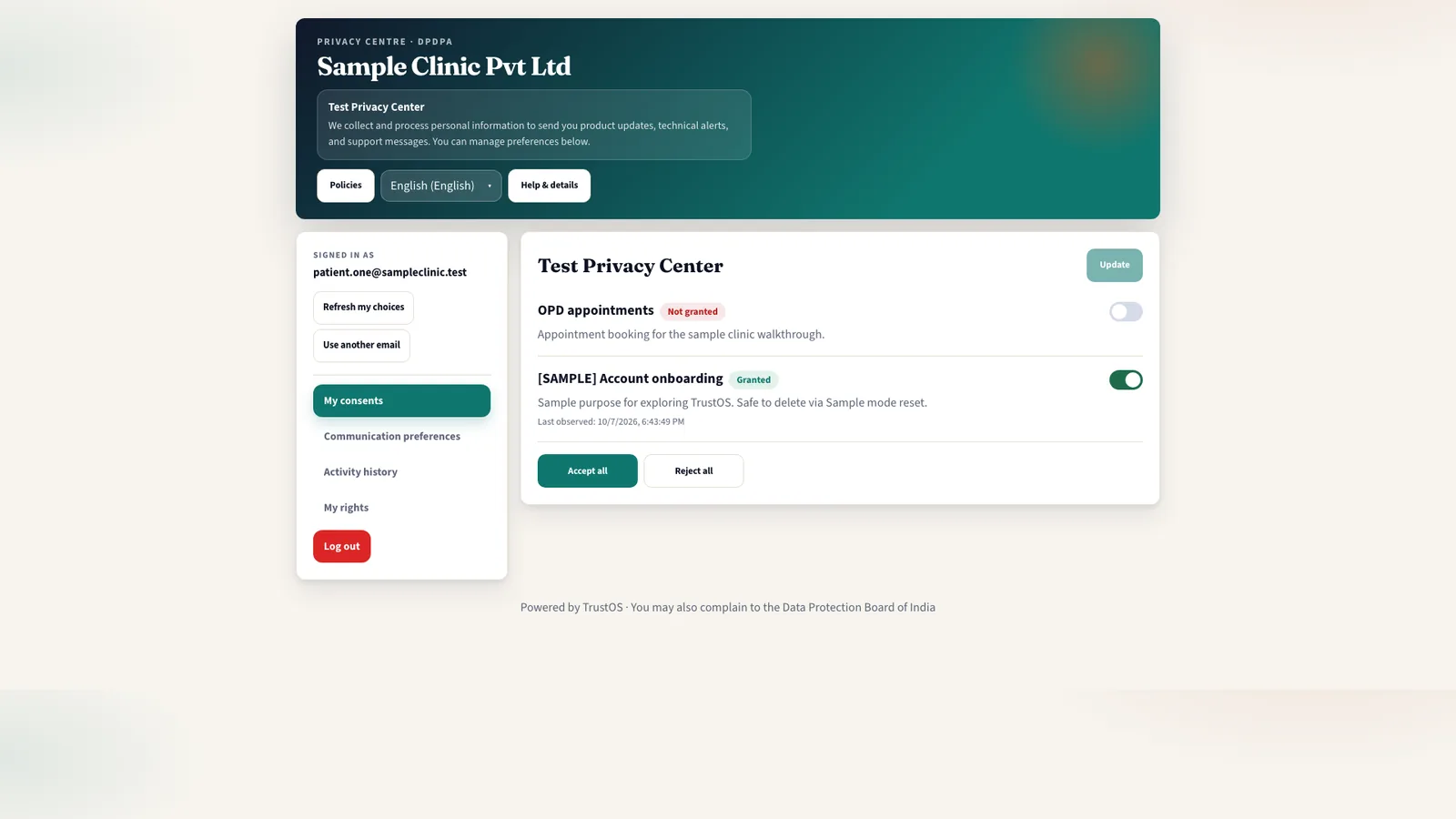
What it looks like in TrustOS · sample data
An example scenario
Illustrative example: a parent closes an account
Suppose a parent ends a Class 8 student's subscription to a test prep app and asks for the data to be deleted. In this hypothetical, the request comes through the Privacy Centre, TrustOS checks it against the parent's verified consent record, and tasks go to remove the recordings, chat logs and activity data. Fee invoices stay, and the parent is told why.
Rules that sit alongside the Act
- Information Technology Act, 2000 and its rules
- UGC regulations on online and open and distance learning
- State and board rules on school records
- CERT-In directions on reporting cyber incidents
TrustOS helps you keep these obligations in the same record. Your counsel decides how they apply to you.
Watch the film
Schools, colleges and coaching centres
Student and parent data, children's consent, and what an education provider needs in place before the duties apply.
For organisations · Education
Schools, colleges and coaching centres
Student and parent data, children's consent, and what an education provider needs in place before the duties apply.
Questions
From education teams
How do we verify that consent really came from a parent?
The Rules describe ways to check that the person is an identifiable adult, such as details you already hold or a token from an authorised entity. Your team picks the method. TrustOS records which method was used for each consent.
Do the children's data rules apply to colleges?
Only for students under 18. Most college students are adults, but first year students in some courses may not be, so it is worth checking dates of birth at admission.
Can teachers use TrustOS?
Teachers rarely need to. Most of the work sits with the operations, technology and privacy teams. Teachers may get a task, for example to delete class recordings from a drive.
For education teams
See TrustOS run on education data
Bring the systems that hold your student names, dates of birth and photos, and the requests your team handles today. We will show the work moving through TrustOS, from the first request to the evidence.
Or get a rollout proposal in two minutes- Step 1A 30 minute demo on Google MeetWith someone who knows the Act and the product.
- Step 2Your systems and purposesWe walk one product's personal data through TrustOS.
- Step 3A first phase you can planModules, owners and effort, written down for you to keep.