
Teams · Technology teams
Erasure that reaches the warehouse as well as the app
Technology teams own the systems where personal data actually sits, and they get the tickets when a request or a retention rule has to be carried out. TrustOS sends that work to the right system through a connector, confirms it was done and keeps the result, so nobody has to prove it later from memory.
What worries this team
The questions that keep coming back

Copies nobody listed
A borrower's data sits in the loan system, the data warehouse, the CRM, the collections dialler and a nightly export to a credit bureau tool. The app team deletes the app record and the request is marked done. Four copies remain.
Requests that arrive as emails
Legal forwards an erasure request with a note saying please action. There is no customer ID, no list of systems and no due date. Someone runs a query by hand and nobody can say afterwards which tables it touched.
Deleting what you must keep
The warehouse table that feeds the RBI returns holds the same loan account as the marketing mart. Delete the wrong one and a regulatory report breaks. Keep both and the erasure is incomplete.
A week in TrustOS
What the work looks like
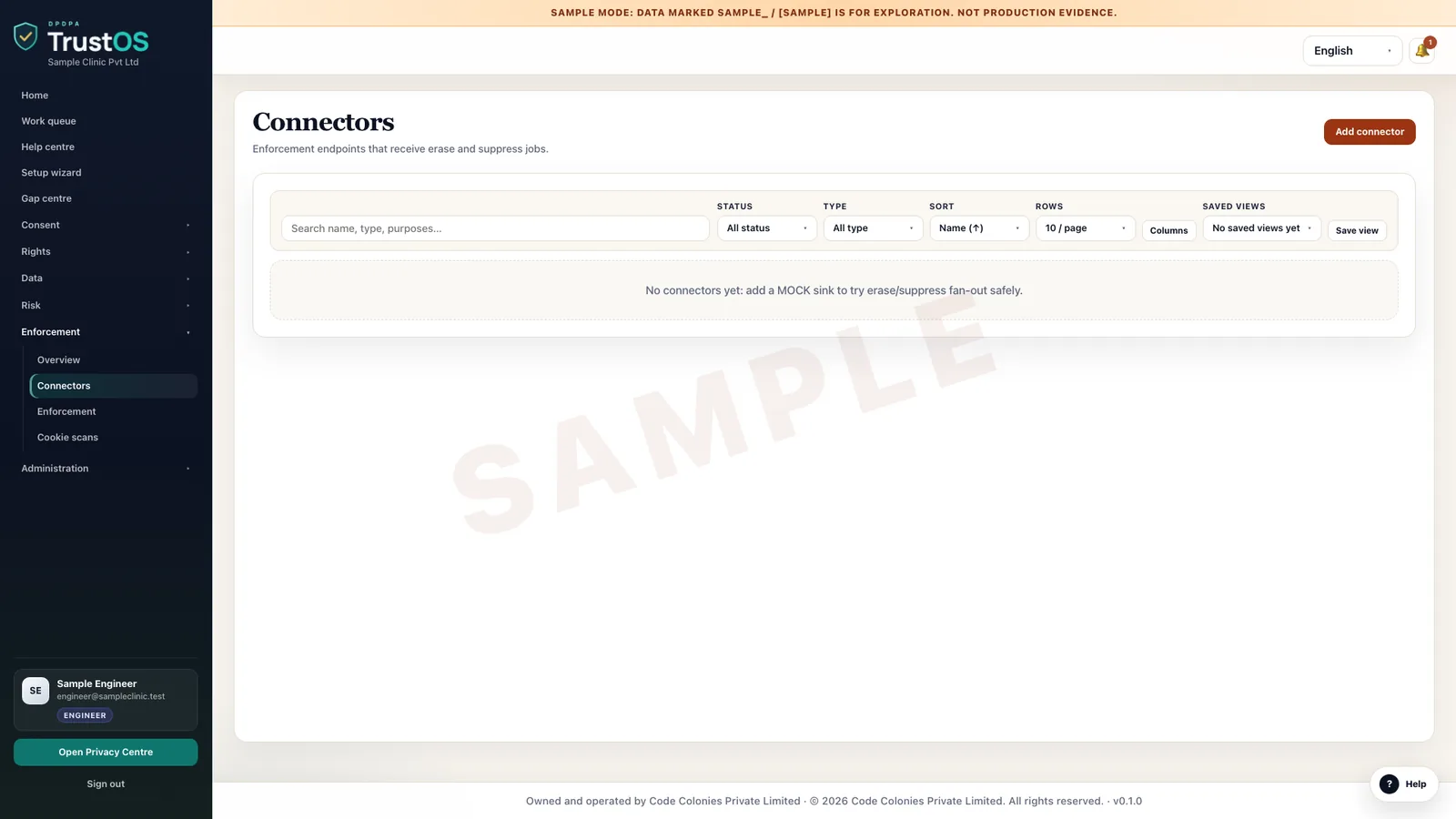
- Step 1Connect the loan system and the warehouseYou register the loan management system through its documented API and the data warehouse through a scoped database account that can only read and update the tables you list. Each connector is mapped to the inventory entries for the data it holds.
- Step 2Wire an erasure request end to endA borrower asks for erasure after closing a personal loan. TrustOS searches both connected systems by mobile number and loan account, shows what was found, and waits for legal's note on what must be kept for statutory reasons before it acts.
- Step 3Run the action and confirm itThe loan system deletes the profile and KYC images. In the warehouse, the marketing mart rows are deleted and the reporting rows are masked, keeping only the loan account and amounts. Each connector reports back what it changed, and the confirmation is stored with the request.
- Step 4Handle the system with no connector yetThe collections dialler has no API. TrustOS creates a manual task for its owner with the phone number to purge and a due date. When they upload the vendor's deletion confirmation, the request can close.
Modules
Where this team spends its time
- Connectors and actionsFind a person's data in your systems, act on it, and record what really happened.Usually leads
- Data inventoryA working record of what personal data you hold, where it sits and who touches it.Works in it
- Retention and erasureDecide how long each kind of data stays, then make sure it actually goes.Works in it
- Rights and grievancesEvery request and complaint in one queue, with owners, due dates and a reply on file.Works in it
The roles in this team: IT and engineering. All roles
Questions
Asked by teams like yours
What access does a connector need?
Only what the action needs. A connector uses a documented interface where the system has one, or a database account scoped to named tables and operations. You decide the scope, and you can review it at any time.
Can TrustOS run inside our own infrastructure?
Yes. It can be deployed in infrastructure you control, with source code handover possible in the agreed scope, or used as a hosted service. Many teams start with two or three connectors and add more in phases.
Who builds connectors for our older systems?
Your team can build them against the documented interface, or our delivery team can. That work runs on 2good terms: you pay after you accept the work.
See it with your data
Show us where your personal data lives. We will show you TrustOS running on it.
A 30 minute walkthrough on Google Meet with someone who knows the Act and the product. You leave with a view of your first phase, the owners and the effort.
Or get a rollout proposal in two minutes- Step 1A 30 minute demo on Google MeetWith someone who knows the Act and the product.
- Step 2Your systems and purposesWe walk one product's personal data through TrustOS.
- Step 3A first phase you can planModules, owners and effort, written down for you to keep.