
Industries · Government services
Citizen data held for public services, handled with the same care
A state department, a municipal corporation or a public sector undertaking collects citizen data to deliver schemes, licences and utilities. Applications come through portals, common service centres and counters, and data is shared with other departments, banks and contractors. Records often go back decades, in systems built at different times.

What you hold
The personal data in a typical week
The register every duty starts from. In TrustOS each category is linked to the systems that hold it, the purposes it serves and an owner.
Data register · Government services6 categories
- Applicant names, addresses and identity numbers
- Aadhaar-linked records, where permitted
- Income, caste and other eligibility certificates
- Bank details for benefit transfers
- Property, utility and licence records
- Grievance and helpline records
Pressure points
Where the DPDP Act bites in government services
Exemptions are narrower than they look
The Act lets the State process data without consent for subsidies, benefits and services, and allows some agencies to be exempted by notification. The Rules still set standards for that processing, such as security and limiting use to the purpose.
Contractors and system integrators
Portals are often built and run by private vendors who have full database access. Their contracts and access need the same checks as any other processor.
Old systems and duplicate records
The same citizen may appear in five schemes' databases with different spellings. Correction requests are hard to complete when nobody knows where all the copies are.
Public accountability
A leak of beneficiary data becomes news quickly. Departments need to show what they hold, who can reach it and what they did when something went wrong.
How TrustOS helps
The modules that matter most here
Map scheme databases, portals and shared files by department, with the owner and vendor recorded for each.
Record the legal basis for each scheme and publish notices in the languages citizens use, including the 22 languages of the Eighth Schedule.
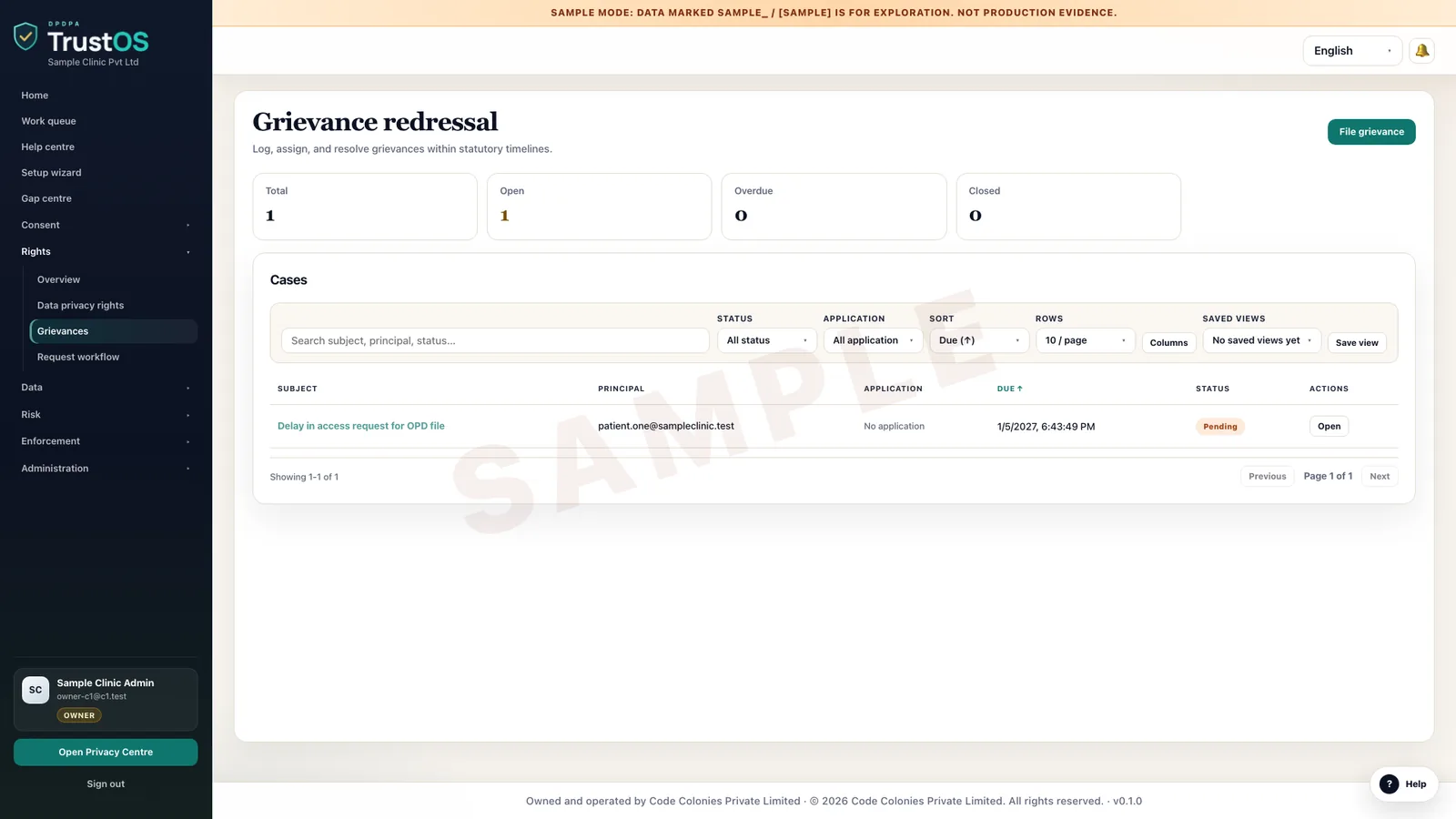
Track correction requests and grievances from citizens through to a reply, across departments.
Assess system integrators and data centre vendors, and keep access reviews on record.
What it looks like in TrustOS · sample data
An example scenario
Illustrative example: a name correction across schemes
Suppose a pensioner's name is misspelt in a state pension scheme, which holds up her bank transfer. In this hypothetical, the department logs her correction request in TrustOS, which shows that the same record exists in two other scheme databases. Tasks go to each owner, and she is told when all three are fixed.
Rules that sit alongside the Act
- Information Technology Act, 2000 and its rules
- Aadhaar Act, 2016 and UIDAI regulations
- Right to Information Act, 2005
- CERT-In directions on reporting cyber incidents
TrustOS helps you keep these obligations in the same record. Your counsel decides how they apply to you.
Questions
From government services teams
Is the government exempt from the DPDP Act?
Not entirely. Some processing by the State and its agencies is exempt or relies on legitimate uses, and the Central Government can exempt agencies by notification. Other duties still apply. The position for your department is for your legal advisers to confirm.
Can TrustOS be deployed on a government cloud or our own data centre?
Yes. TrustOS can run inside infrastructure you control, with source code handover possible within the agreed scope.
Can we start with one department?
Yes. A pilot with one department or scheme is a sensible start, before adding others in phases.
For government services teams
See TrustOS run on government services data
Bring the systems that hold your applicant names, addresses and identity numbers, and the requests your team handles today. We will show the work moving through TrustOS, from the first request to the evidence.
Or get a rollout proposal in two minutes- Step 1A 30 minute demo on Google MeetWith someone who knows the Act and the product.
- Step 2Your systems and purposesWe walk one product's personal data through TrustOS.
- Step 3A first phase you can planModules, owners and effort, written down for you to keep.