
Industries · E-commerce and D2C
From the WhatsApp order to the courier label, know where customer data goes
A D2C skincare brand might take orders on its website, on WhatsApp and through marketplaces. Each order sends a name, phone number and address to the payment gateway, the courier partner, the WhatsApp provider and the marketing tool. Abandoned carts, reviews and loyalty points add more data every day.

What you hold
The personal data in a typical week
The register every duty starts from. In TrustOS each category is linked to the systems that hold it, the purposes it serves and an owner.
Data register · E-commerce and D2C6 categories
- Names, phone numbers and delivery addresses
- Order and return history
- WhatsApp chats and support tickets
- Payment references from the gateway
- Browsing, cart and campaign data
- Reviews, photos and loyalty records
Pressure points
Where the DPDP Act bites in e-commerce and d2c
Marketing on a phone number given for delivery
A customer gives a number so the courier can call. Adding it to WhatsApp offer broadcasts is a different purpose and needs its own ground.
Data spread across many SaaS tools
The store platform, the CRM, the email tool, the courier aggregator and the review app all hold copies. An erasure request has to reach every one.
Small teams, no privacy officer
Many D2C brands have a founder, a growth lead and an agency. The work needs to be simple enough to run without a dedicated privacy team.
Large marketplaces and inactivity
The Rules set an inactivity erasure duty for e-commerce entities above a user threshold. A growing brand should know where that line sits.
How TrustOS helps
The modules that matter most here
Record order updates and WhatsApp offers as separate choices, and pass a withdrawal to the broadcast tool.
Link the Privacy Centre from the store footer so customers can stop offers or ask for erasure without writing to support.
Find a customer across the store, CRM and email tool and confirm the deletion in each, where an integration exists.
Keep a short record of each courier, agency and app vendor, and what they are allowed to do with customer data.
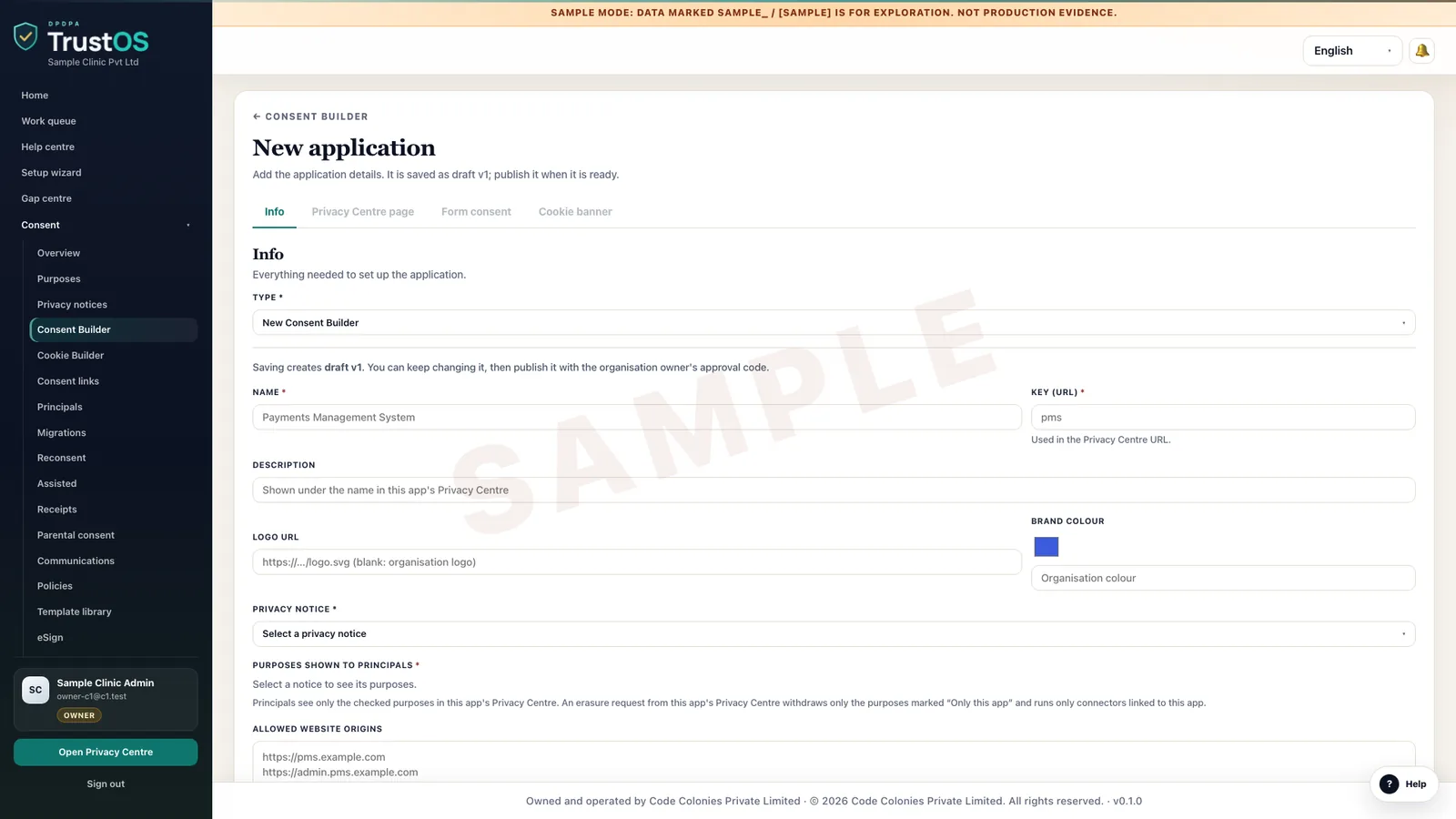
What it looks like in TrustOS · sample data
An example scenario
Illustrative example: erasure across five tools
Suppose a customer of a home décor brand asks to be forgotten after a bad delivery. In this hypothetical, TrustOS creates one request, finds her in the store platform, CRM and email tool through connectors, and gives the operations lead manual tasks for the courier portal and the review app. Invoices stay for tax purposes, and the reply tells her so.
Rules that sit alongside the Act
- Consumer Protection (E-Commerce) Rules, 2020
- TRAI regulations on unsolicited commercial communication
- GST law on keeping invoices and accounts
- CERT-In directions on reporting cyber incidents
TrustOS helps you keep these obligations in the same record. Your counsel decides how they apply to you.
Watch the film
Online stores and D2C brands
Every order starts at checkout. Shopper data, partner contracts and breaches, for online stores.
For organisations · Online stores
Online stores and D2C brands
Every order starts at checkout. Shopper data, partner contracts and breaches, for online stores.
Questions
From e-commerce and d2c teams
We are a small brand. Is TrustOS too much for us?
You can start small: an inventory of your tools, a notice, consent records and the Privacy Centre. Other modules can wait until you need them.
Does TrustOS work with Shopify or our own store?
TrustOS connects through a documented interface or scoped database access. Where a ready connector does not exist, our team can build one, and tasks can still be assigned to a person in the meantime.
Do we need consent for order SMS and delivery calls?
Data a customer gives to get an order delivered is usually processed for that purpose. Marketing is a separate purpose. Your counsel should confirm the ground for each flow, and TrustOS records it.
For e-commerce and d2c teams
See TrustOS run on e-commerce and d2c data
Bring the systems that hold your names, phone numbers and delivery addresses, and the requests your team handles today. We will show the work moving through TrustOS, from the first request to the evidence.
Or get a rollout proposal in two minutes- Step 1A 30 minute demo on Google MeetWith someone who knows the Act and the product.
- Step 2Your systems and purposesWe walk one product's personal data through TrustOS.
- Step 3A first phase you can planModules, owners and effort, written down for you to keep.